
Perfect greens. Lower costs.
Biological moisture infrastructure for modern golf courses. Keep tournament-quality turf while cutting irrigation 60–90%, replacing chemical wetting agents, and building days of drought resilience into the root zone.
Superintendents are caught between greens and budgets.
Across the Southwest, water districts are raising tariffs 13% to over 40%, exemptions for golf are disappearing, and volumetric caps and penalties are taking their place. Pumping, labor and chemical costs keep climbing too.
Rising water costs
Tariff hikes, volumetric caps and over-allocation penalties hit the biggest line in the budget.
The surfactant treadmill
Chemical wetting agents wash out and must be reapplied every 2–4 weeks, and they don't add any water-holding capacity.
Aeration downtime
Core aeration takes 10–14 days to heal, forcing discounted green fees and lost tee times.
From chemical treatments to living reservoirs.
Aleterra feeds the native soil biology already adapted to your course. Fungal networks expand through the root zone and produce glomalin, binding soil into stable aggregates. Large pores drain and aerate; small pores hold water right next to the roots.
- Two seasonal applications instead of biweekly surfactant drenches
- Builds natural resistance to compaction
- Holds nutrients in the root zone and reduces runoff
- Fits into your existing aeration and topdressing routine
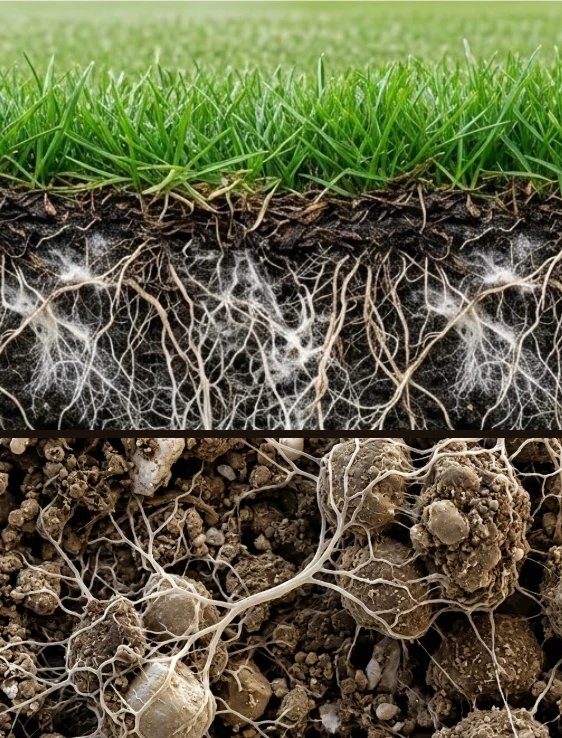
Proven under extreme Southwest conditions.
Less water
Whispering Winds Golf Course cut water use by 80% within four months.
Drought resilience
Treated ultra-dwarf bentgrass greens went 4 days without irrigation at peak summer heat. Untreated greens lasted under 24 hours.
Less core aeration
Fewer disruptive aerations on greens, and potentially none on fairways and roughs by year 3.
Net ROI
Modeled 3-year return from water, pumping, chemical, sand and labor savings, plus protected green-fee revenue.
Savings compound as the biology establishes: modeled at 75% in year one, 80% in year two and 85% from year three on.
Surfactants vs. biological infrastructure.
| Chemical surfactants | Aleterra | |
|---|---|---|
| How it works | Breaks surface tension chemically | Builds a stable fungal "living net" that holds water |
| Application frequency | Every 2–4 weeks, forever | 2 seasonal applications |
| Soil biology | Degrades it over time | +410% fungi, +70% microbiota (Sandia) |
| Compaction resistance | None | High, from glomalin-bound aggregates |
| Drought resilience on greens | Under 24 hours | Up to 4 days |
Water by data, not by the clock.
Buried sensors track moisture at 2, 4 and 8 inches, plus salinity, soil oxygen and root-zone temperature. Our open API can talk to your central irrigation computer and skip or shorten cycles when the soil doesn't need water.
Sense
Sensors confirm the root zone is holding moisture and oxygen, even in 95°F heat.
Communicate
The telemetry platform sends an instruction to your central irrigation computer.
Adjust
Run times drop, or cycles are skipped entirely, zone by zone.
From perceived water drain to community steward.
Saving up to a million gallons per irrigated acre each year leaves more water in shared aquifers. Nutrients stay in the root zone instead of running off, and your course has hard data for Audubon International and GEO certification.
Aquifer preservation
Tens of millions of gallons stay in regional aquifers and river basins every year.
Less runoff
Nutrients bound in the root zone mean far less fertilizer leaching into groundwater.
Scope 1–3 reductions
Fewer tractor hours, less pumping electricity, less freight, and carbon stored in the soil.
Let's model your course.
Tell us your acreage and water source, and we'll show you what the savings look like.