
Proven. Tested. Validated.
Our claims are backed by independent federal science, commercial field results and live telemetry.
 Sandia National Laboratories
A multi-year federal field study.
From 2022 to 2024, Sandia National Laboratories tested Aleterra's formulations against standard synthetic nitrogen fertilizer in Tucumcari, New Mexico, under severe semi-arid conditions (Report SAND2025-10092).
- 410% increase in fungal populations and 70% increase in total microbiota at the 3–6 inch root depth
- 300% more biomass than crops given synthetic nutrients alone
- Synthetic fertilizer, by contrast, cut fungal populations by 74%
- Nitrous oxide spikes measured within 12 hours of synthetic fertilizer application, showing biological soil restoration as a path to lower greenhouse gas emissions

Results in the field, not just the lab.
Sandia proved the mechanism. Deployments on golf courses, city parks and public grounds across the arid Southwest have proven the performance. Two were closely measured:
Less water in 4 months
Whispering Winds Golf Course, Cannon AFB, New Mexico.
Without irrigation
Treated greens at Whispering Winds held up 4 days in peak summer heat. Untreated greens showed stress in under 24 hours.
Less irrigation in 29 days
Tularosa City Hall, Tularosa, New Mexico.
Proven in the arid American Southwest.
The technology has been deployed on golf courses, city parks and public grounds in some of the hardest growing conditions in the country.
- Whispering Winds Golf CourseCannon AFB
- Inn of the Mountain GodsMescalero
- City of Santa FeParks and Recreation
- City of AlamogordoParks and Recreation
- City of Truth or ConsequencesParks and Recreation
- City of ArtesiaParks and Recreation
- City of HobbsParks and Recreation
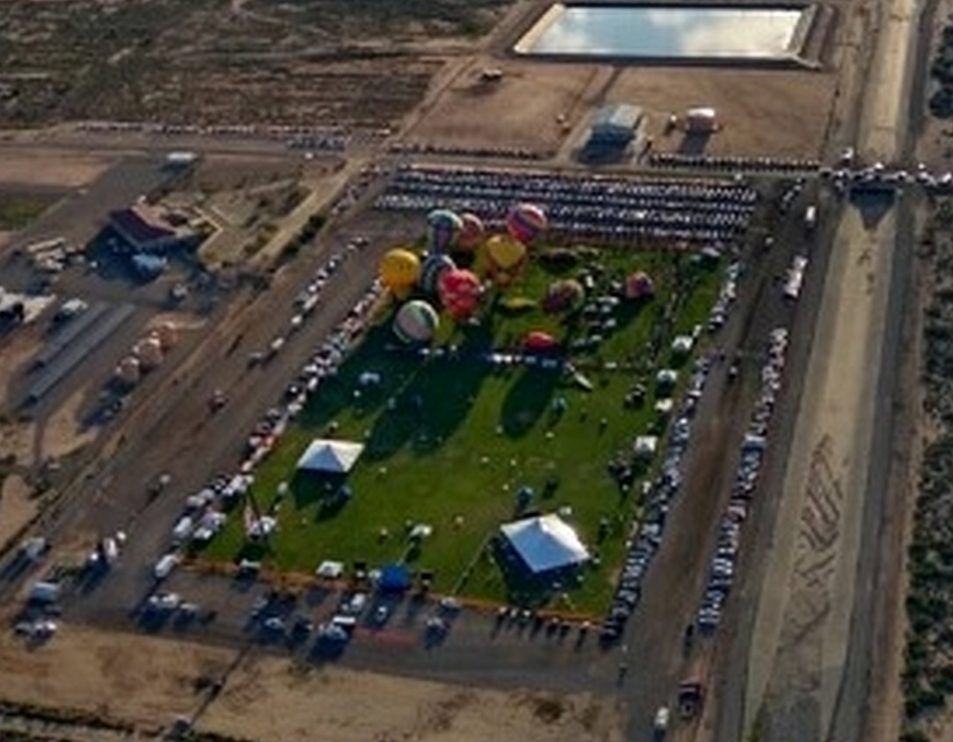
- Ed Brabson Balloon ParkAlamogordo
- Tularosa City HallTularosa
- New Mexico School for the Blind and Visually ImpairedAlamogordo
See the difference.
Before Aleterra, the technology's inventor deployed it on municipal lawns, event fields and home landscapes across southern New Mexico. Here's one city hall lawn before treatment and in the weeks after.
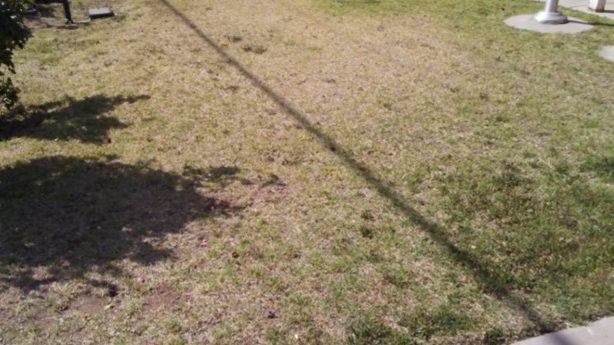 Before
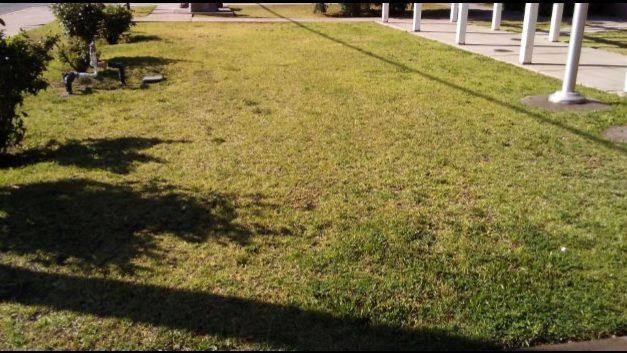 7 days
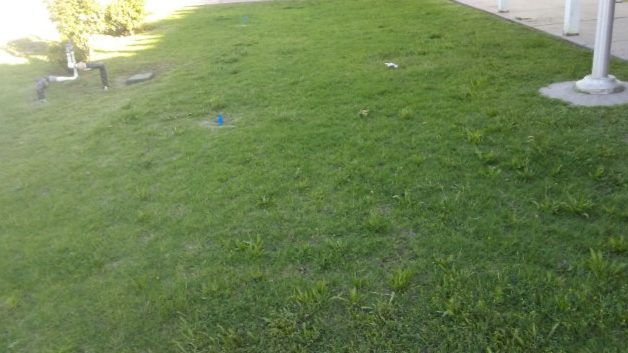 29 days
Tularosa, New Mexico City Hall, 2019. An early municipal deployment of the technology: irrigation was cut 33% over these 29 days.
The biological engine.
Aleterra is a feed for microbes, not a live inoculant. It wakes up the dormant biology already adapted to your site and restarts the natural process that stores water and carbon in soil.
Explosive microbial growth
Aleterra feeds dormant microbiology. Fungal networks expand dramatically, extending the effective reach of every root.
Structural soil re-engineering
Fungi produce glomalin, which binds soil into stable aggregates: large pores for drainage and air, small pores that hold water next to roots.
The liquid carbon pathway
Plants feed carbon to the fungi, which lock it into mineral-bound organic matter that can persist for centuries.
Every deployment is measured.
Underground sensors, irrigation flow meters, and satellite and weather data set a baseline before treatment and track results continuously afterward. You see water reduction as it happens, with data ready for regulators and auditors.
See what the data says about your site.
We'll walk you through the studies and model the savings for your land.